If you’ve been watching the Boise and Treasure Valley housing market and wondering whether the slowdown of the past couple of years has finally turned a corner, the July 2026 numbers offer a clear answer: yes. Across Ada and Canyon counties, closings are up, inventory is tightening, and prices are climbing again — modestly, but steadily. Here’s what’s actually happening on the ground, county by county.
The Big Picture: A Market Finding Its Footing
Treasure Valley buyers closed on 8,642 homes so far this year, a 14% increase — 1,034 more transactions — over the same point in 2025. Combined pending sales are running at 2,065 a month, up 183 units. That’s not a market in decline; it’s a market that’s absorbed higher rates and simply kept moving.
Some of that comes down to sheer population growth. Ada and Canyon counties have added roughly 150,000 residents since the 2020 Census, pushing the region’s population past 876,760 — growth of more than 20% in just a few years. That kind of demand doesn’t disappear just because mortgage rates are elevated.
The local job market is holding up its end too. Boise–Nampa metro unemployment sits around 3.3%, with healthcare, tech, construction, and manufacturing all competing hard for workers. And while mortgage rates haven’t offered buyers any real relief, and inflation remains persistent, people are transacting anyway — a sign of a market driven by genuine need rather than speculation.
Ada County Resale: Inventory Keeps Shrinking

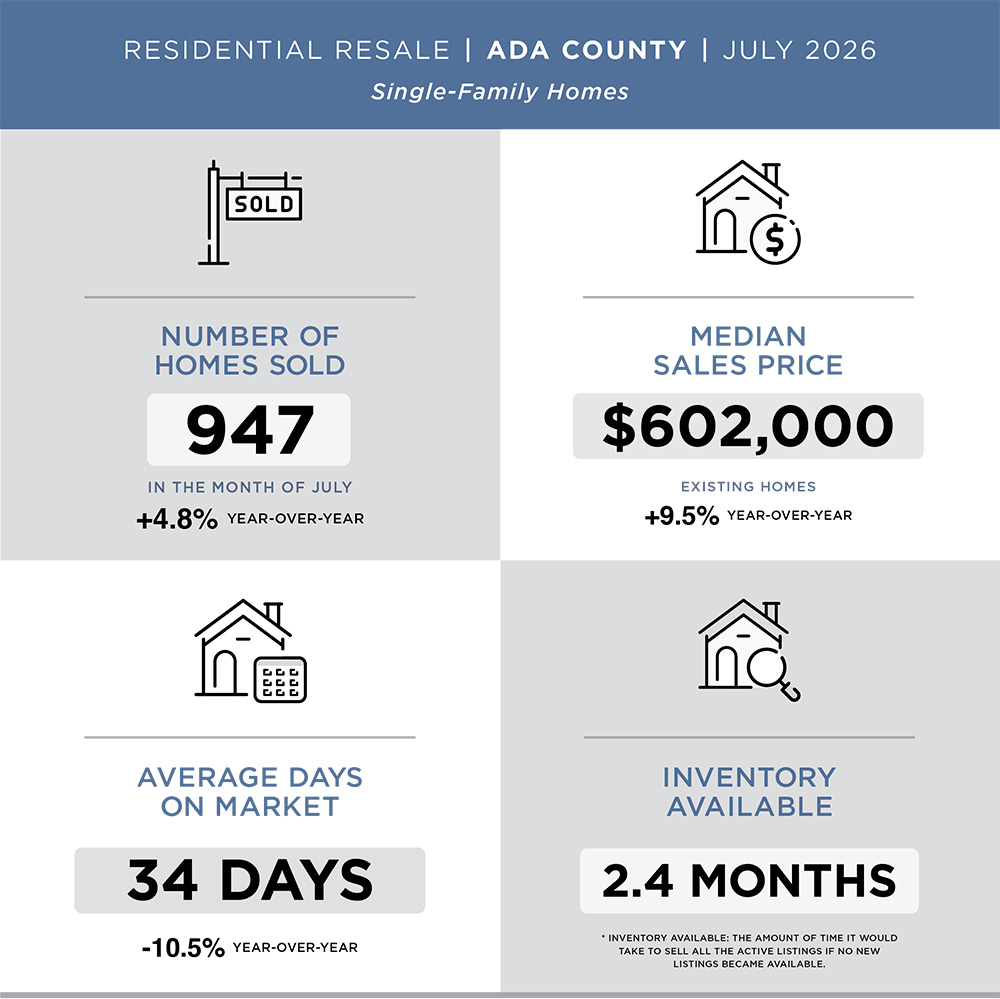
Ada County’s resale market is the clearest signal of where things stand. Year-to-date closings reached 3,657 homes, up 15% (490 units) over last year, while the average sales price climbed 2% to $633,035.
The more telling number is inventory. Active listings dropped 14% to just 961 units, holding months of supply at a lean 1.91 — essentially flat month over month, but firmly in seller-favoring territory. Pending sales are also up 11% to 839 a month, which suggests that tighter supply isn’t slowing deal flow; if anything, buyers are moving faster to secure homes before options thin out further.
Canyon County Resale: Still the Value Play

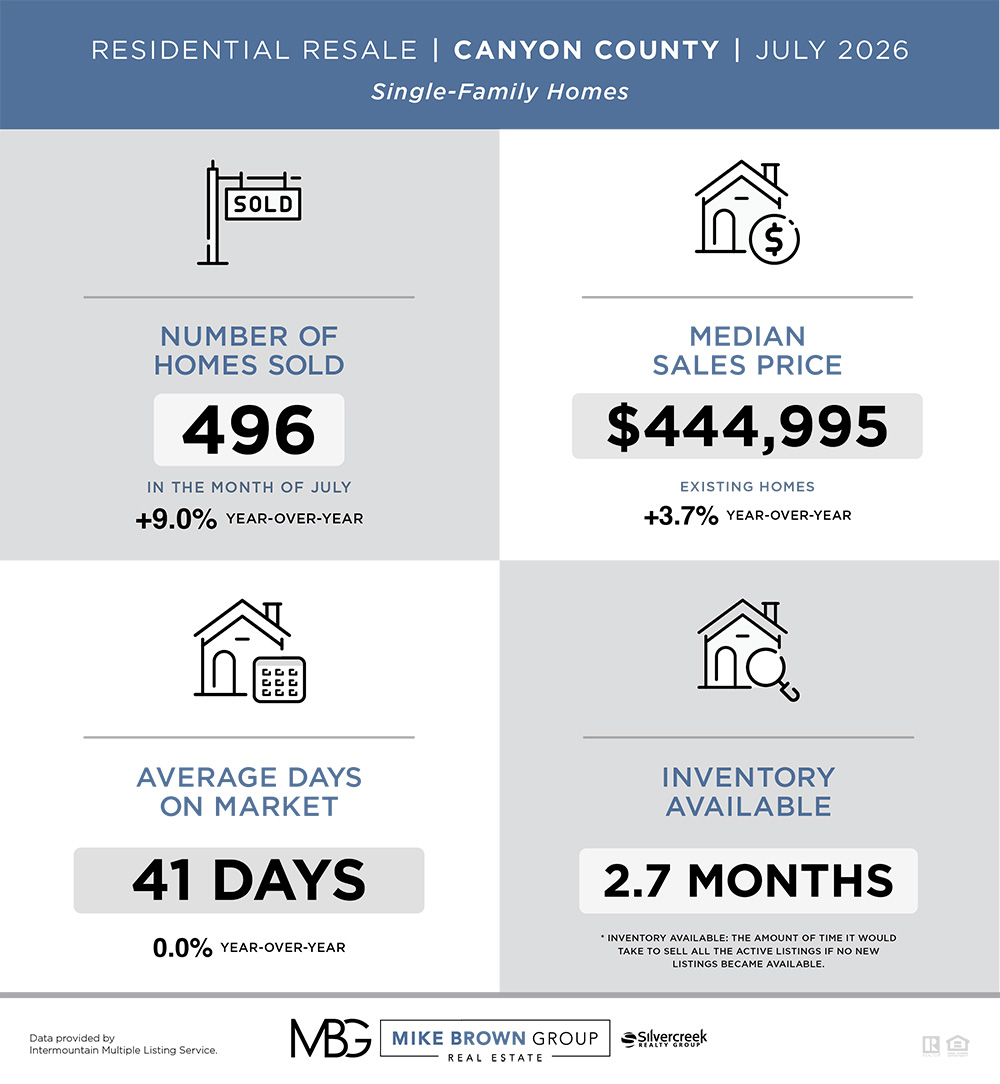
For buyers priced out of Ada County, Canyon County continues to be the release valve. The average resale price there is $427,332 — roughly $206,000 below Ada County — while closings are up an even stronger 17% year-over-year to 1,584 homes.
Inventory tightened here too, down 57 units to 454 available homes, with months of supply holding steady at 2.05. That combination of rising sales and shrinking supply is keeping values well supported even at the more affordable end of the Treasure Valley market.
New Construction: Builders Hold the Line on Pricing
New home construction tells a similar story to resale, with one notable difference: builders are managing to keep price growth modest even as demand stays strong.
In Ada County, new home closings are up 20% year-to-date to 2,068 units, with average pricing up just 1% to $669,022. Available inventory fell 13% to 728 units, and months of supply dropped to 2.43 — under the 2.5-month threshold that typically signals a tightening, seller-leaning market. Pending new home sales across both counties combined climbed 9% to 1,226 a month.
Canyon County’s new construction segment is smaller but just as resilient. Closings rose 13% to 135 units, with average pricing up about 2% to $501,136. Inventory is essentially flat at 480 units, and months of supply sits at 2.75 — steady and still favoring sellers.
What This Means If You’re Buying or Selling
For sellers, the math is straightforward: inventory is shrinking across every segment — resale and new construction, in both counties — while closings and pending sales keep climbing. That’s the kind of environment where well-priced homes move, and it’s worth having a conversation about timing if you’ve been on the fence about listing.
For buyers, the takeaway is a little more nuanced. Mortgage rates haven’t budged in your favor, but waiting for inventory to loosen up doesn’t appear to be a winning strategy right now — supply is moving in the opposite direction. Canyon County remains the strongest option for buyers prioritizing affordability, while Ada County continues to command a premium tied to its deeper job market and amenities.
Either way, the numbers point to a Treasure Valley market that’s stable, still growing, and absorbing economic headwinds better than a lot of national headlines would suggest.
Data source: Ada & Canyon Counties MLS, July 2026. Compiled by The Mike Brown Group.
Frequently Asked Questions
Is the Treasure Valley housing market recovering in 2026? ▸
Yes, as of July 2026 the Treasure Valley market is recovering, with 8,642 year-to-date home closings across Ada and Canyon counties — a 14% increase over the same point in 2025.
What is the average home price in Ada County in 2026? ▸
The average resale price in Ada County reached $633,035 as of July 2026, up 2% year-over-year, according to MLS data.
What is the average home price in Canyon County in 2026? ▸
The average resale price in Canyon County is $427,332 as of July 2026 — roughly $206,000 below Ada County — making it a more affordable option in the Treasure Valley.
Is housing inventory shrinking in the Treasure Valley? ▸
Yes, active resale inventory in Ada County dropped 14% to 961 units, and Canyon County inventory fell by 57 units to 454 homes, tightening supply across the region.
Is it a buyer’s market or seller’s market in the Treasure Valley right now? ▸
The market is leaning toward sellers, with months of supply at 1.91 in Ada County and 2.05 in Canyon County — both below the 6-month threshold that typically signals a balanced market.
How many homes have sold in Ada County so far in 2026? ▸
Ada County recorded 3,657 resale closings year-to-date through July 2026, a 15% increase (490 units) over the same period in 2025.
How many homes have sold in Canyon County so far in 2026? ▸
Canyon County recorded 1,584 resale closings year-to-date through July 2026, up 17% year-over-year.
How is new home construction performing in the Treasure Valley? ▸
New home closings are up 20% year-to-date in Ada County (2,068 units) and 13% in Canyon County (135 units), with builders keeping price growth modest at 1-2%.
What is the unemployment rate in the Boise-Nampa metro area? ▸
The Boise-Nampa metro unemployment rate sits around 3.3%, with healthcare, tech, construction and manufacturing sectors all competing for workers.
Why is the Treasure Valley population growing so fast? ▸
Ada and Canyon counties have added roughly 150,000 residents since the 2020 Census, pushing the region’s population past 876,760 — growth of more than 20% in just a few years.
Should I sell my home in the Treasure Valley right now? ▸
Shrinking inventory combined with rising closings across resale and new construction in both counties makes it a favorable environment for well-priced listings to move quickly.
Where is the mo re affordable place to buy a home in the Treasure Valley? ▸
Canyon County remains the more affordable option, with an average resale price of $427,332 compared to $633,035 in Ada County.